So we had an eventful few days, full of fish, fun and sun.
We went out and did some seining oh the Elakha cove and on the open beach, recording what species we saw and how many there were of each. It was fun going out with Scott and Luis, our new teacher and TA.
Here's our group shot out on the beach.

So we had an eventful few days, full of fish, fun and sun.
Later in the week, we went out on the Elakha and did some trawling. It was really fun to go out on the water. We split up in to two groups with one group going out on the boat and one going to the aquarium to do a sort of fish scavenger hunt. I was in group 1, so I got to go out on the boat first. We motored up the river a bit to sites 4 and 5. We put the trawl in; everyone had a job to do. I recorded all the data from dissolved oxygen and temperature to how many fish and crabs we got in the nets.
Scott is telling us what we'll be doing and telling us what jobs need to be done.
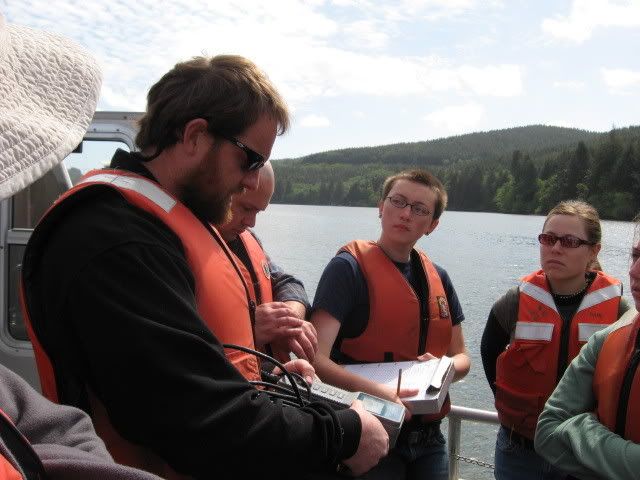
Here's a group shot of everyone working together.

It turns out that group 2 broke the net on their first trawl, so they just went on a nice, relaxing cruise around the bay while Group 1 did all the work. All I know is, I really liked getting to do the trawling, seeing how it works and actually catching fish. A nice boat ride is fun, but I guess I am too much of a nerd to want to just sit still for it, when I could be collecting specimens and recording data.
Back in lab, we had several different families of fish. There was family Syngnathidae, the family which includes seahorses, represented by the Bay Pipefish. we had Vinny the Starry Flounder, family Pleuronectidae and Gary the Staghorn Sculpin, family Cottidae.
Here's a picture of Gary from when we caught him on the beach....He's so cute! For a fish...

Later in the week, we took trips to both Boiler Bay and Strawberry Hill to do some more fish collectings, running around the tidepools with our little goldfish nets. We caught lots and lots of sculpin, a couple gunnels, snailfish, a clingfish and a goby. At the end of the week we compiled all our data from the 6 locations (The cove and the open beach seine, site 4 and site 5 from the trawl, Boiler Bay, and Strawberry Hill) and looked at the species richness and diversity, using the Shannon-Weaver Index.
Turns out, the cove and the beach had the most species diversity. This was probably due to the fact that there were several schools of fish passing by when we did our second seine out there...Oh well.
Thursday, as everyone frantically studied and tried to finish lab drawings, disaster struck. Gary was dead! Who could have done it?? Why would they do such a thing?? Why were we keeping him in a tank, away from his natural habitat and expecting him to live?? Oh...that's our bad.
We were all quite surprised to find Gary slowly defrosting in the lab come friday...he was part of the lab practical! The irony, the slightly disturbing irony of it all....poor Gary.
RIP Gary. We love you. May you live on with the ctenophore in the special place all who die in the name of research go; Memphis.
By the way...fish are pretty cool. That's what I learned.


