Showing posts with label Tokatee Klootchman. Show all posts

Sunday, May 5, 2019

Week 5: Fish, Fishes, and More Fish

Monday: We had lovely weather for our beam trawls out in the Yaquina Bay estuary. We went in three groups out on the R/V Elakha, which we learned means otter. We had a guest scientists, Dr. Lorenzo Cannelli, teach us to use beam trawls and deploy CTDs to take salinity, temperature, oxygen, and depth measurements. Our trawls were focused on catching, measuring, and counting juvenile English sole (Parophrys vetulus). We also found some gunnels, a showy snailfish, and tons of shrimp and juvenile crabs! We sampled upstream and downstream in the bay to see if there was a difference in density, mean size, and size range. The final cruise found the largest English sole of the day at 15.6 cm. After returning from the trawls and a lunch break we went to class and had a lecture on early life history and recruitment of fishes. Then we did our data analysis on the trawl data we gathered that morning.  
Kendal deploying the CTD with Dr. Lorenzo Ciannelli's guidance. 
Students measuring and counting English sole.
Tuesday: We spent the morning in lectures on age and growth; swimming, schooling and migration; and scientific writing to begin preparing for the trawl reports. After lunch, we got a chance to go out into the field again before the long night of writing ahead. We went to Tokatee Klootchman State Park and hunted fish among the tidepool. At the end of our hour of searching and catching fish, we held the award for the biggest, smallest, most unique, most colorful, and best Cabezon caught. We also had one of the highest catches from the tidepools in BI 450 history. Good Job Everyone! After returning from the field, when we were identifying the fish, we found that we had caught a ringtail snailfish (Liparis rutteri). What is interesting about finding the ringtail in Tokatee Klootchman was that in our guide books, they said that the most southern places it has been reported was southern Alaska. Which is cool for us, seeing it so far south in Oregon, meaning that they may be possible migrating down to more southern waters, and we may be seeing more of them. Another cool find was a silver Cabazon (Scorpaenichthys marmoratus), the silver color is due to the Cabazon just migrating from the open ocean to tidepools. It was a late night (and early morning for some) writing to prepare our trawl reports for peer revision Wednesday.
Searching for tidepool fish at Tokatee Klootchman State Park.

A collection of sculpins we found at Tokatee.
Wednesday: We began the day with lecture on the different way fish feed and food webs in the ocean. Then we had a break for donuts and coffee in the staff lounge. After that, we got a temporary break from fish and had a guest lecture about plankton ecology from Dr. Moritz Schmid. We learned about various tehnologies for collecting zooplankton; including the coupled multiple opening/closing net and environmental sensing system (MOCNESS) that Su helped design and how artificial intelligence is being used to conduct image analysis to obtain higher resolutions for plankton counts. After a break for lunch, we brought our trawl reports in and peer reviewed each others papers, providing edits and feedback to improve our final papers. We ended the day by learning how to prepare and deploy light traps out to catch zooplankton, which we deployed off the pumphouse docks in Yaquina Bay. Finally, we went home and made final adjustments and edits to our trawl reports based on our peers’ feedback and prepared for a busy Thursday.

Students after deploying the light traps. Students after retrieving the light traps.
Thursday: We retrieved our light traps first thing in the morning to see what caught. Before we got to identify the zooplankton and juvenile fish from the traps we had to turn in the trawl reports and we had our final lecture for the term! We learned about population ecology and fish conservation, a precursor to our Marine Policy section in a few weeks. Then we got to identify and enumerate the juvenile fishes and zooplankton our light traps caught. We learned to use a sieve to separate and count the large organisms(over 3.3 mm) and a stempel pipette to take 5 mL subsamples to count the small organisms(under 3.3 mm). After lunch, we split into groups and got to print fish with the help of guest artist Bruce Koike. It was a nice break and a creative outlet. With the trawl report turned in and the last lecture over, our attention turned to studying for Friday’s final and the end of the section.
The class showing off our fish prints!
Friday: Another week, another final. After a busy week full of fishes, papers, and field work we spent the morning studying and finishing notebooks to prepare for the end of the fishes section. In the afternoon we took our final, cleaned the lab, released our fishes back into the estuary and turned in our field and lab notebooks. We then headed for a relaxing weekend in between our next course, Community Ecology starting Monday.

Monday, April 8, 2019

Week 1- Hello Hatfield!

Monday

Monday was the first day of our term here at Hatfield! There are 27 of us starting our journey to becoming scientists and we are the largest class size in the history of this course being taught. It’s crazy! It was a long day, starting with an orientation to the course and a tour of the facilities. We got to see the lab that we will be calling our second home for the next ten weeks and we learned about life at Hatfield and in Newport. That included learning about Donut Wednesdays, Sailing Wednesdays, Tiki Tuesday, and all the cools spots around town. Then we had our first two lectures of the term about the history of the Oregon coast and why studying marine biology is important. Later in the night we took a “Tsunami walk” going along the tsunami evacuation route to Safe Haven Hill, where a shipping container of supplies sits ready for when “ the Big One” happens. It rained the whole walk and we were soaked when we came back… and the forecast for the rest of the week says it’s supposed to rain. Our night ended with sharing pies and getting to know our classmates who we will be spending a lot of time with and living next to for the next ten weeks. We learned where everyone’s from, their majors, and their dream jobs some of which included being the next Steve Irwin, a racecar driver, and a food critic/geneticist. All in all it was a good (though very wet) first day.


Tuesday

Our second day at Hatfield was the day of our first field trip! In the past years that this course has been taught the field trip days typically meant early mornings catching low tides, but this week our field trips meant late (not that late but still) nights as low tide was forecast for between 5:00 pm and 7:00 pm. So, lucky us because we didn’t have to be at class until 9:00 am every day this week. Our day started off with two lectures, one introducing us to marine invertebrates and the other about phylum Porifera. After lunch our first assignment was already due, and it’s only day two! We then all got dressed in our rain gear and boots not knowing what to expect from our first field trip. We got to Tokatee Klootchman and thankfully it wasn’t raining. We made our way down to the tidepools and got to work searching for any and all invertebrates we could find. We quickly spread out searching for cool inverts. We found many Nucella ostrina (stripped dogwinkle), Anthopleura elegantissima (aggregating anemone), Anthopleura xanthogrammica (giant green anemone), and Pagurus spp. (hermit crab) right off the bat. After a little while the nudies (nudibranchs) began to show up left and right; we found many Hermissenda crassicornis and Rostanga pulchra, which are both very brightly colored species, there were also some Aeolidia papillosa. Some people (Allison) waded up to their waist to get a look at some Pisaster ochraceus. We ended the trip slightly wet, with a large haul of many chitons, snails, hermit crabs, and nudies.


Wednesday

On Wednesday we started our day with a lecture about Cnidarians and Ctenophores which was very interesting. We then headed to the staff lounge at Hatfield for Donut Wednesday. We got to talk to many researchers, NOAA officers, and other professionals in the marine biology field over coffee and donuts. It was awesome! We then went to the lab to work on identifying the many animals we collected the night before at Tokatee. We spent a large portion of our day in lab IDing organisms and starting to work on our notebooks, drawing species. That afternoon we headed for Boiler Bay all geared up for what was supposed to be another rainy day. Luckily when we got there it wasn’t raining anymore. We made the steep climb down to the tide pools and were off searching again for new invertebrate species. We found the glorious Cryptochiton stelleri, which is a GIGANTIC chiton, and people took turns passing around one that was rolled into a ball. We found some new species we didn’t previously have like Tonicella lineata (lined chiton), Strongylocentrotus droebachiensis (green urchin), and a few really cool sea stars. We made our way back up the steep cliff side, at least a few of us were a little sore after the climb. Then we ended our day by bringing our finds back to the lab and putting them into a tank.


Thursday

The day started out with two lectures all about worms. We learned about the many different kinds of worms and their different morphologies and life styles. After lunch we were back in the lab IDing our species we found at Boiler Bay and working more on our notebooks which were due at the end of the week. We worked on drawing species, classifying them and writing descriptions about them. After a few hours of lab work we got geared up for a field trip to the tide flats. We had to be ready to get muddy, so those of us that weren’t wearing proper waders duct taped our rain pants to our boots to keep our boots on and the mud out. Unfortunately, our good luck with the weather came to an end, and it rained while we were out in the field. We made our way out to look for worms, clams, shrimp, and whatever else we could find living deep in the mud. It didn’t take long for people to get stuck and start getting covered in mud. We found a few burrowing shrimp, Upogebia pugettensis and Neotrypaea californiensis. Most of the Upogebia we found had a parasitic isopod under their carapace (Orthione griffensis). When we made our way back to shore some of us opted to wash off in the stream that led into the bay while the rest of us waited until we go back to clean up. When we got back Ashley and Grace's boots were stuck on their feet because there was a lot mud in them! They finally got them off with the help of Eric, Megan, and a hose. We put our specimens in the lab and quickly went home to shower, clean up and rest.


Friday

On Friday we started the day off with a lecture about the phyla Arthropoda (crustaceans and insects) and Tardigrada (tardigrades). Did you know tardigrades can survive in space and maybe even originated there?! After lecture we unfortunately had 25+ mph wind, so instead of our planned trip to Cascade Head we switched a few days around and went to Newport Docks instead. We collected a variety of jellyfish and captured a couple of ctenophores, one of which was one of my favorite invertebrates, the sea gooseberries (Pleurobrachia bachei)! After spending a very, very long time staring at our beautiful, nearly invisible finds we got to work finishing up our scientific drawings and characteristic definitions that were due at 5:00 pm.


Saturday/Sunday


Dr. Sylvia Yamada, a researcher studying the invasive European Green Crab, worked with some volunteers from our class to set up a variety of crab traps. She taught them how to set up, bait, and put out the traps. With a total of about 25, the hope is we can catch some of the invasive crabs and take some measurements. We’ll be back with some of the results next week!

Sunday, April 23, 2017


SOMETHING'S FISHY...

After a brief break in both classes and coursework, a new week brings a new professor, a new TA, and a new subject: FISH!
Group photo from day one at Tokatee Klootchman
Monday:
We dipped our toes into the new subject right away, spending the morning sloshing through the tide pools at Tokatee Klootchman in search of intertidal fish. In our rainiest field trip yet, we scooped up sculpin and gathered gunnels, bringing the best specimens back to the lab. After a brief lecture on general anatomy, we tried our best to apply what we learned, attempting to identify a number of fish specimens.
Tuesday:
Paige and Nick wading through the water to do a beach seine.
Everybody loves a beach day! We spent the afternoon at an estuary beach, while a select few braved the water to drag seine nets and capture fish. We sorted, counted, measured, and identified a number of species, including pipefish, flatfish, and juvenile salmon. Our biggest catch of the week, with a TL of approximately 22cm, was Leptocottus armatus, the Pacific Staghorn Sculpin. This little excursion was followed by lecture on reproduction and life history, allowing us to better understand the journey of the young fish we had just caught.
Wednesday:
As everyone was beginning to tire, we fought the mid-week blues with break in the morning for coffee and donuts. This was followed by a guest lecture from Dr. Bob Cowen about kelp forests and rocky reef habitats. We managed to experience a number of other habitats while escaping the stormy weather with an afternoon adventure to the AQUARIUM. Naturally, everyone gravitated to the open ocean exhibit, where sharks and rays take center stage.
Enclosed in the Aquarium’s longest tunnel, the class relaxed into a state of admiration and awe at the wonders of the deep. Sketching and photography ensued, along with identification of species and discussion of anatomical differences. The “Open Sea” exhibit houses 5 species of shark, schools of mackerel and anchovies, and bat rays. The largest shark species on display was the Broadnose Sevengill shark, Notorhynchus cepedianus. This shark is common along the Oregon Coast and can be identified by its unusual number of seven gills. Because of their gill number, they are thought to be related to ancient sharks, as fossils from the Jurassic period also boast seven gills. This oddity gives them the Guinness Book of World Records title for most gills!
Thursday:
Elakha cruise group two posing as their favorite fish: the English sole!
Thursday was the most highly anticipated day of the week: we got to spend the morning out on the Elakha, beam trawling and sorting fish for our research project. The early morning crew fought rain and sleepy eyes, but managed to have a blast. The afternoon crew was a bit luckier with the weather, and had just as much fun measuring and identifying fish. After a much needed lunch break, the afternoon took a slower pace, with a lecture on swimming and schooling followed by analysis of the trawl data. A small group of students then assisted Su and Miram in deploying light traps off the Pump House dock.


Friday:
The final day of the week was all about the class room! We had the pleasure of two guest lectures, from Dr. Wayne Hoffman and Dr. Christian Breseño-Avena, about herring and plankton, respectively. Our lecture on plankton was immediately followed by a plankton identification lab. We used microscopes to identify species and count plankton, determining that in one light trap we had collected over 125,000 planktonic organisms!

This week was packed full of lectures, field adventures, and fish! The week went swimmingly, but there is still a lot more schooling to do before we finish up the section on fishes.

Sunday, April 9, 2017

Welcome to HMSC BI 450!

Today marks week one of our time here at Hatfield for BI 450, it has been very busy but extremely fun. 9 am Monday morning we all migrated the 500 feet from our apartments to the classroom for a tour of the campus and introduction to the staff. We later learned about the landscape of the Oregon coast and why marine biology is important (even though Sally was preaching to the choir).


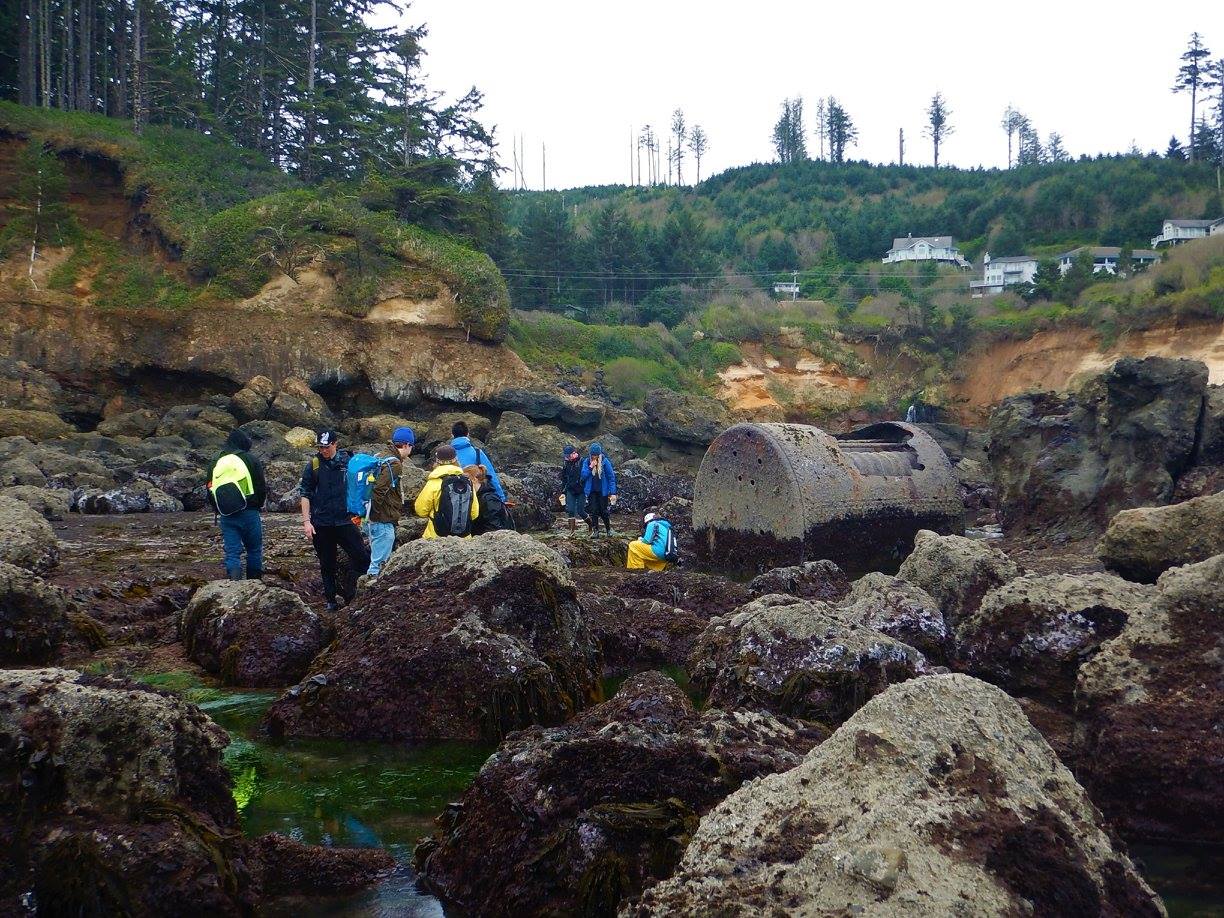
Students collecting invertebrates at Boiler Bay. On the right is a
boiler from an old ship that crashed here 107 years ago, hence
the name: Boiler Bay. 
Tuesday was more eventful, we began learning marine invertebrate phylums, starting with Porifera -the sponges. We then went out for our first day of fieldwork to Boiler Bay. The tide pools were amazing and rich with biodiversity. Everyone clomped around in their raingear with little cups and sketchily rust scrappers collecting animals. This trip had probably the highest turnover rate of all our trips this week, collecting organisms from crabs to snails to nudibranchs to urchins to chitons and so much more.


Wednesday we learned about anemones, corals and jellies of the phylum Cnidaria then were inaugurated into the HMSC wide tradition of coffee and donut break. Of course free donuts were great, but it was also nice to talk to staff at Hatfield that we otherwise wouldn’t interact with. We learned about their research and helpful hints about the town -such as where to find agates, chanterelles and good hikes. After some lab work and lunch we drove out to Tokatee Klootchman for more fieldwork. This intertidal was harder to find organisms in -especially since we had already collected so many the previous day- but we were able to expand our inventory, including many Aeolidia papillosa and a Hermissenda crassicornis!
17799997_1695497823799816_2980754842915698521_n.jpg
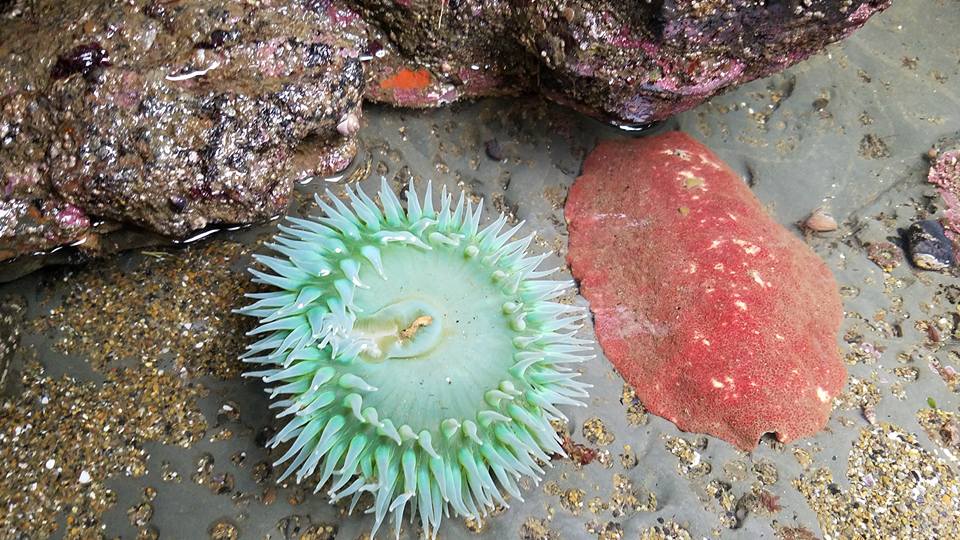
Right: Anthopleura xanthogrammica
Left: Chrytochiton stelleri
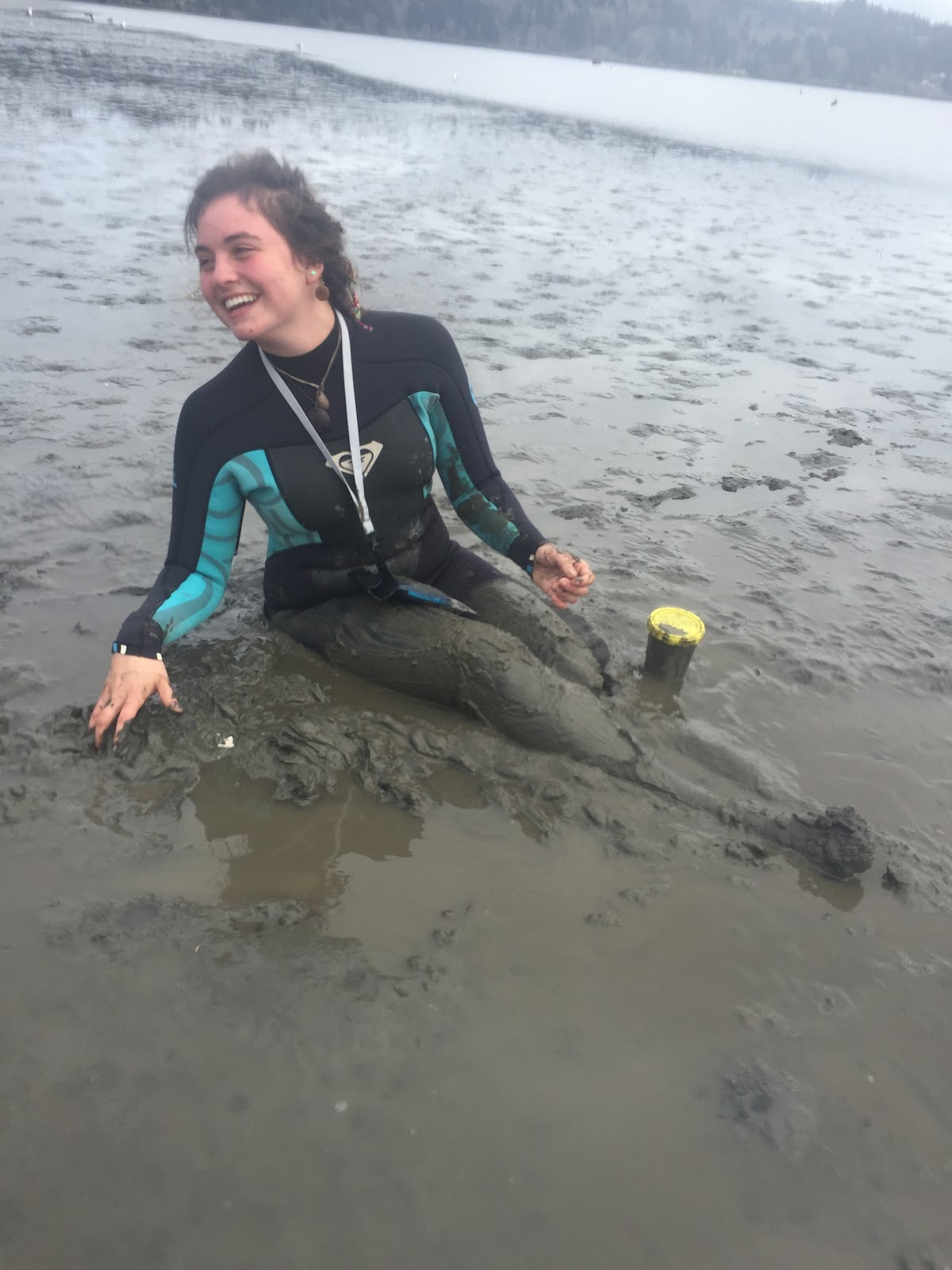
Thursday was probably the most exciting day of the week. We started the morning off with some awesome worm lectures and then headed off to the mudflats to collect more invertebrates. Before leaving, Sally surprised everyone with some chocolate cake for Miranda’s twenty-first and Sammy’s twenty-second birthdays (thanks Sally!). The mudflats were a blast. The mud was extremely hard to walk through because it was so soft and deep. Almost everyone took a fall or two! The most adventurous of us managed to get all the way to the water’s edge where we were waist deep in mud and had to resort to crawling on our hands and knees to keep from sinking. Despite the challenge, we found tons of worms, crabs, and shrimp that we took back to the lab, along with lots of mud!
IMG_5041.JPG
Alanna digging for worms!
Friday went a little differently than we had planned. We were supposed to go on a fun hike up to Cascade Head, but the strong winds and heavy rain forced us to change our schedule around. Instead, we had some interesting lectures on Molluscs and Lophophorates, and then lots of lab time to finish up the three notebook entries that were due at the end of the day.
Saturday was Marine Science Day at Hatfield. The education building was packed with booths and exhibits showing off scientists’ research and educating the public about the wonders of the ocean. We took turns telling guests about all of the invertebrates that we had collected in the field this week, which turned out to be a pretty handy study tool for our final next Friday! It was really fun to see everyone so excited about marine biology. David also turned twenty one and got to share his day with Marine Science Day!


While walking on the beach this weekend we found hundreds of stranded Velella velellas due to the high winds on Friday. This was especially interesting because we had just learned about this species in lecture on Wednesday. These jellies have clear ‘sails’ that project out of the water and catch winds to locomote. 50% of the population is born with sails twisted to the right and the other 50% has sails twisted to the left. This means that large winds will separate the population in half to opposite sides of the Pacific ocean.

Saturday, April 4, 2015

Spring 2015 - First Week at Hatfield

Week 1: Welcome and Marine Invertebrates 
Saturday April 4, 2015
By Kaitlin Lebon and Issie Corvi 

Last weekend, after much anticipation, the new set of BI 450 students settled into their new homes.  Our first day consisted of a Hatfield crash course, including tours, orientations, and our first official lecture.  With the basics under our belts, we waited eagerly for our field and lab work to begin. 

Boiler Bay
Vanessa, Ari, and David identifying invertebrates at Boiler Bay
                  Despite the tides not being completely in our favor, we were able to venture out into the intertidal zones of Boiler Bay to explore its populations of invertebrates.  The class eagerly delved into the task of collecting specimens to bring back to our lab for further investigation and identification.  A class favorite was a large red chiton, Cryptochiton stelleri, fondly known as the wandering meatloaf because of its size and mottled color. Other species that were found included the purple sea urchin (Stronglyocentrotus purpuratus), the aggregating anemone (Anthopleura elegantissima), and the kelp crab (Pugettia producta). 
Kat looking for Sipunculids in the roots of seagrass at Boiler Bay  

Kaitlin recording her findings at Boiler Bay
Later that evening we gathered in the dining hall to discuss Oregon geology and to become more acquainted with one another.  We also we treated to pie courtesy of our instructor, Sally Hacker. 

Tokatee Klootchman
A purple Pisaster ochraceus at Tokatee Klootchman 
                  Our second field excursion took us out to Tokatee Klootchman, a site just south of Cape Perpetua.  We continued our task of collecting various intertidal invertebrates.  This site was a favorite for many in the class.  As with past BI 450 classes, we quickly discovered and fell in love with the various species of colorful nudibranchs.  We were also pleased to find that there was a significant population of healthy looking sea stars—encouraging news in wake of the sea star wasting sickness that has been prevalent along the Oregon Coast.
In lecture we learned about sponges, anemones, corals, and jellies. 
The population density at Tokatee Klootchman was incredible - countless Mytilus californianus (mussles), Balanus glandula (acorn barnacle), and Pollicipes polymerus (gooseneck barnacle) (among others) occupied the intertidal. 

Mud Flats of Yaquina Bay
                  Thursday morning we ventured our early in the morning to the local mudflats.  With some last minute words of advice from our instructor Sally Hacker, we were knee deep in mud before we knew it.  Some of us were able to navigate the sticky depths of mud better than others, but in the end we were all able to discover various shrimps and worms to bring back with us. 
Later in lecture we were told about the various types of worms, many of which we had collected that day.
The class after collecting on the Yaquina Bay mud flats. 


Cascade Head

                  By Friday, our good fortune with the weather had ran out.  Our hike up to Cascade Head to view coastal headlands and estuaries was a wet one.  The trail on the way up was very slick and muddy.  Upon arriving at the top of the trail, we quickly took a group photo, and clambered back down to the vans to escape the adverse weather.  Although it would have been better to have had more favorable weather, it was still an enjoyable hike.